— Conditions · Sciatica & Nerve Pain
Acupuncture for Sciatica Relief & Nerve Pain
That electric line of pain from your low back down the leg has a logic to it. Understanding the logic is how acupuncture for sciatica relief earns its keep — here is our approach in McLean, minutes from Tysons.
Quick answer
Acupuncture for sciatica relief is a needle-based therapy that treats points along the path of the sciatic nerve — low back, hip, and leg — with thin sterile needles retained for about 20 to 30 minutes to help ease nerve irritation and the muscle spasm that aggravates it. At Harmony Acupuncture & Wellness Spa in McLean, VA, an initial session is 60 minutes for $150 and follow-ups are 30 minutes for $100, with a 5 session package at $400. Open 7 days, 9 AM to 9 PM, on Chain Bridge Rd with free parking. Research suggests acupuncture may help reduce sciatica pain for many people, though it cannot change the disc or bone structure that often starts it.
- Initial visit
- $150 · 60 minutes
- Follow-up
- $100 · 30 minutes
- Package
- 5 sessions · $400
- Walk-in area
- Free parking · Ste 300
— 01
Understanding Sciatica
Sciatica is not a diagnosis. It is a description — pain radiating along the sciatic nerve, the thick cable that runs from your lower spine through the buttock and down the back of each leg. Something is irritating that nerve, and the usual suspects are few.
Common causes
- Herniated or bulging disc — the most frequent culprit, pressing on a nerve root as it exits the spine
- Spinal stenosis — age-related narrowing of the channels the nerves travel through
- Piriformis syndrome — a deep hip muscle clamping down on the nerve itself, common in runners and people who sit all day
- Degenerative disc changes — a disc that has thinned enough to crowd the nerve's exit
The pattern tells the story. Pain below the knee, tingling in the foot, a leg that feels weak on stairs — these point to nerve involvement rather than ordinary back pain, which tends to stay in the back and buttock. Sitting often makes sciatica worse. So does the drive down the GW Parkway you cannot avoid.
Red flags — see a physician now
A few presentations need urgent medical evaluation, not acupuncture:
- Progressive leg weakness, a foot that slaps or drags, or numbness that keeps spreading
- Numbness in the groin or inner thighs, or any new trouble controlling bladder or bowels — signs of cauda equina syndrome, an emergency
- Sciatica in both legs at once
- Leg pain with fever, or after significant trauma
Everything else — the aching, burning, electric but stable sciatica most people have — is reasonable to treat conservatively first, which is where we come in.
— 02
How Acupuncture Delivers Sciatica Relief

Sciatic nerve pain arises through two mechanisms at once, and a good treatment addresses both. There is the nerve irritation itself — chemical and mechanical — and there is the secondary muscle spasm: the glutes, piriformis, and low back muscles that tighten around the painful area and, in doing so, often compress the nerve further. A vicious loop.
Our licensed practitioners needle points at several places along the chain. Close to the spine, where the nerve roots exit. Deep in the hip, where the piriformis crosses the nerve. And distal points down the leg and even at the ankle, which — in both TCM channel theory and modern neurology — may influence signaling along the whole pathway. Needling appears to encourage the release of the body's own pain-modulating chemicals, may improve local blood flow, and can coax spasming muscle to let go. Patients often describe the leg feeling "quieter" after a session, though how long that quiet lasts varies widely at first.
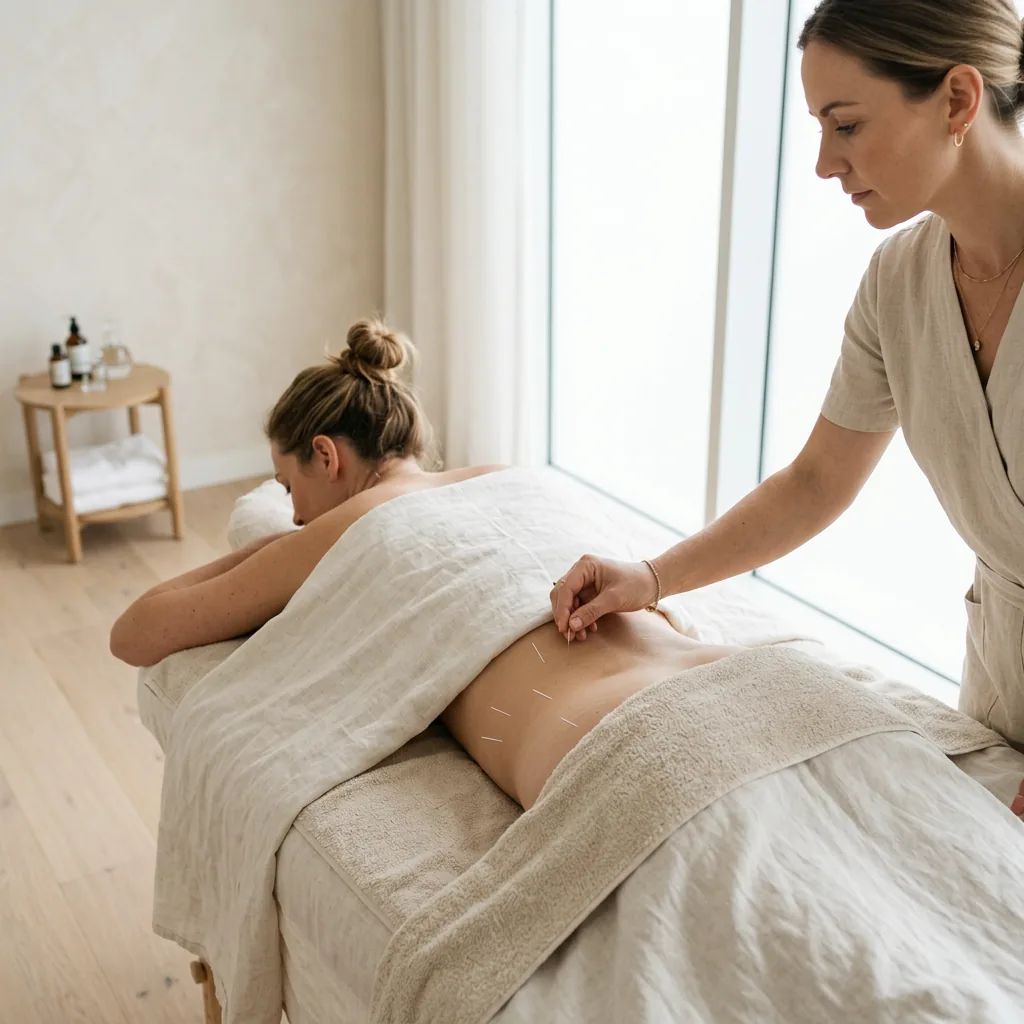
Sessions themselves are calm. You rest face-down or on your side in a private room, needles do their slow work for 20 to 30 minutes, and most people leave moving a little easier than they arrived. Not a magic fix. A nudge, repeated, in the right direction.
Depth and precision matter more with sciatica than with surface-level muscle pain, which is one reason this is not a condition for a weekend-certificate provider. The piriformis sits beneath the gluteal muscles; reaching it safely takes anatomical training and a steady hand. Every session here is performed by licensed practitioners with single-use sterile needles — and if a point placement ever feels sharply electric down the leg, you say so and we adjust. Strong sensation is common in sciatica treatment; pain is not the goal.
— 03
What Research Shows — and its limits
Sciatica sits inside the broader chronic pain evidence base, which is substantial. The National Center for Complementary and Integrative Health reports that acupuncture may help several chronic pain conditions, with low back pain — sciatica's usual source — among the best studied. Reviews of sciatica trials specifically have reported reduced pain intensity with acupuncture compared with some conventional comparators, though researchers consistently note that many of those trials are small and study quality is mixed. "Promising but imperfect evidence" is the fair summary.
The limits deserve equal billing. Acupuncture cannot shrink a herniated disc, widen a stenotic canal, or reverse degenerative change — imaging looks the same after a course of needling as before. What may change is pain signaling, muscle spasm, and your ability to move while the underlying irritation settles, which for most disc-related sciatica it gradually does over weeks to months. Acupuncture is best understood as support for that natural course, not a replacement for it. And if a surgeon has told you a structural problem needs repair, needles are not a substitute for that conversation.
Because the evidence is honest rather than triumphant, our advice is too: give it a defined trial — several sessions — and judge by your own leg, not by anyone's marketing.
— 04
Combining Acupuncture, Cupping & Tui Na

Sciatic nerve pain responds well to layered treatment, because the problem itself is layered. Three therapies under our roof work together:
- Acupuncture targets nerve irritation and deep muscle spasm along the sciatic path — the core of the plan.
- Cupping therapy uses gentle suction over the low back and glutes to draw blood flow into tissue that has been clamped tight for weeks. Many patients find it releases the surface layers so needling can reach the deeper ones.
- Tui na medical massage works the hip rotators and hamstrings by hand — useful when piriformis tension is a main driver, and a good maintenance option once the sharp pain has settled.
A common sequence: acupuncture as the backbone, cupping added during the tight early weeks, tui na introduced as the leg calms and the goal shifts from pain control to restoring normal hip mechanics. If you book a massage session, cupping and gua sha are $20 add-ons — free for members.
One practical note for Tysons and Vienna commuters: follow-up sessions run 30 minutes, which fits inside a real lunch break. We are just off Route 123, about 10 minutes from Tysons Galleria, with free parking at the door — details on our McLean clinic page.
— 05
Sciatica Relief Timeline
Nerve pain rewards patience more than intensity. Here is the arc we typically see — expectations, never guarantees:
| Phase | Focus | What to expect |
|---|---|---|
| Visits 1–2 | Assessment; calming the angriest segment of the nerve path and easing hip spasm | The first visit is 60 minutes including consultation. Early relief, when it comes, is often partial and temporary — a few hours or days of a quieter leg. |
| Visits 3–6 | Extending relief windows; working the piriformis and low back drivers | Many patients find the pain retreats up the leg over these weeks — from foot to calf to buttock — a pattern clinicians read as improvement. |
| Reassessment | Honest progress check | Improving? We space sessions out. Flat after 6 visits? We say so, and talk about imaging or a physician referral instead of more of the same. |
| Recovery phase | Restoring sitting tolerance, walking distance, sleep | Occasional sessions plus the home stretches we teach you. Recurrences happen; catching them early usually means a shorter course. |
Through it all, keep moving as much as your leg allows. Bed rest feels intuitive and reliably makes sciatica worse — short frequent walks, even to the end of a McLean cul-de-sac and back, serve the nerve better than the sofa.
Self-care while the nerve calms down
- Break up sitting. Sciatica hates long sits more than almost anything. Stand every 20 to 30 minutes, even briefly; on long drives, build in stops.
- Adjust the car seat. Slightly reclined, hips no lower than knees. Many patients find a small lumbar roll turns the Beltway commute from a flare trigger into a neutral event.
- Sleep smart. Side-lying with a pillow between the knees, or on your back with a pillow under them, tends to take pressure off the nerve overnight.
- Skip the deep stretch marathon. Aggressive hamstring stretching often irritates an angry sciatic nerve. Gentle motion first; ambitious flexibility later.
- Keep a simple log. Where the pain reaches each day — foot, calf, knee, buttock. Watching it retreat up the leg is both encouraging and clinically useful.
Questions about whether your particular pattern fits this approach? Call or text 240-715-5939 and ask — a two minute conversation with our team beats a week of guessing.
— Pricing
| Acupuncture | Price |
|---|---|
| Initial session · 60 minutes | $150 |
| Follow-up session · 30 minutes | $100 |
| Package · 5 sessions (30 minutes each)($80 per visit) | $400 |
Insurance patients: sessions are billed through your plan — text us your policy info for a free benefits check.
Parking & arrival
Free parking — easy in, easy out on Chain Bridge Rd
Open every day 9 AM – 9 PM — lunch-break, after-work, and weekend visits all fit.
- Park free directly on-site at 1481 Chain Bridge Rd, Ste 300 — no garages, no meters.
- Look for the red-brick building; we're in Ste 300 with signage at the entrance.
- Arrive 10 minutes early for your first visit to settle in — WiFi and a snack bar are waiting.
— Questions
Asked & answered.
How long does it take for acupuncture to help sciatica?
Can acupuncture fix a herniated disc?
Is my pain sciatica or ordinary back pain?
Where do the needles go for sciatica?
Can I drive home after a session?
— Research & references
NCCIH — Chronic Pain and Complementary Health Approaches
Reviews evidence that acupuncture may help chronic pain, including low back pain — the most common source of sciatica.
NCCIH — Cupping
Explains what is known about cupping; evidence remains limited, and the circular marks are an expected, temporary effect.
NCCIH — Traditional Chinese Medicine: What You Need To Know
Background on TCM approaches and the current state of research on their safety and effectiveness.
Citations are summarized — please consult the original sources. This page is general health education, not medical advice for your specific case; results vary and acupuncture works best alongside, not instead of, care from your physician.
— Keep exploring
Condition
Acupuncture for Back Pain
When the pain stays in the back — including Medicare's 12+8 coverage.
Condition
Neck & Shoulder Pain
The upper-body cousin: tech neck, desk tension, trapped shoulders.
Service
Tui Na Medical Massage
Hands-on work for the hip rotators that often drive sciatic pain.
Location
Acupuncture in McLean, VA
Chain Bridge Rd clinic — pricing, insurance, free parking, directions.