— Harmony Journal · Stress & Sleep
Acupuncture for Stress — and for sleep. A McLean evidence review.
High-pressure careers, short nights, a wired nervous system. What acupuncture may realistically offer McLean professionals — and where the evidence stops.
Quick answer
Acupuncture for stress and sleep is a mind-body practice in which a licensed acupuncturist places thin sterile needles at calming points while you rest for 30 to 60 minutes in a quiet room. At Harmony Acupuncture & Wellness Spa on Chain Bridge Rd in McLean, an initial session is $150 for 60 minutes, follow-ups are $100, and the clinic is open 9 AM to 9 PM every day. Research suggests relaxation-based approaches may reduce stress symptoms; the evidence for insomnia specifically is more limited.
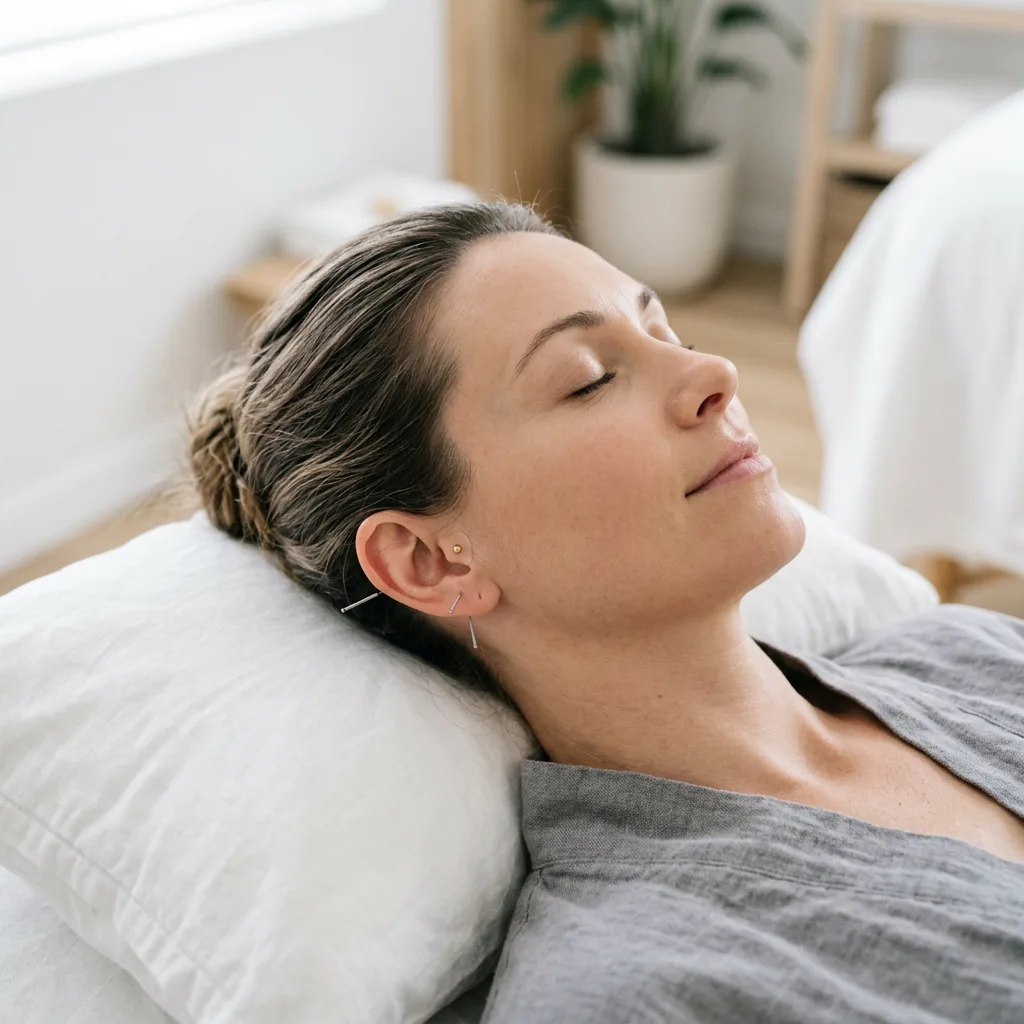
- Focus
- Stress, anxiety & sleep
- Evidence
- Stronger for stress than for insomnia
- Hours
- 9 AM – 9 PM, 7 days a week
- Initial visit
- $150 · 60 minutes
— 01
A third of adults aren't sleeping enough. McLean is no exception.
The CDC has tracked American sleep for years, and the headline number barely moves: roughly 1 in 3 adults reports getting less than the recommended 7 hours a night. Northern Virginia has no exemption. Fairfax County's own community health assessments repeatedly list mental health among residents' top concerns, and in the Virginia Hospital Center service area, roughly 12 percent of adults rate their own mental health as poor. Behind those flat statistics sits a very local rhythm — the 6:40 AM merge onto the GW Parkway, the badge-in before sunrise, the laptop reopened at 9 PM after the kids are down.
Acupuncture for stress and sleep is one of the things people in this zip code quietly try. Nationally, stress relief and sleep sit near the top of the reasons Americans seek out acupuncture that are not pain. And unlike a supplement or an app, it demands the one thing a McLean calendar resists most: an hour of doing absolutely nothing.
McLean's version of stress has a particular texture, too. This is a zip code of security clearances and partner tracks, of Langley shift schedules and school-board evenings, where many households run two demanding careers at once. The stressors are not exotic — deadlines, caregiving, the Route 123 crawl — but they are unusually relentless, and they respond poorly to advice that begins with "just relax." Whatever you try has to fit inside a calendar that is already full, which is part of why a scheduled, bounded hour holds appeal here.
This article is our attempt to be straight about what that hour can offer. We run an acupuncture clinic on Chain Bridge Rd; we obviously believe in the work. But the research on stress is not the research on sleep, the two get blurred constantly in wellness marketing, and the distinction changes what you should expect — and how you should measure whether it is working for you.
Short version: the acupuncture stress case is reasonable, and the acupuncture sleep case is unproven-but-plausible. The full evidence review below is worth five minutes.
— 02
What the trials on acupuncture, stress and sleep really measured.
Two files, not one. It is worth separating the acupuncture stress file from the acupuncture sleep file before you read a word of research, because they were built by different trials, graded by different reviewers, and they do not deserve the same confidence.
On stress, the federal research picture is cautiously positive. NCCIH — the NIH center that evaluates complementary health approaches — notes that several mind-body practices may help reduce stress symptoms, and Mayo Clinic includes needle-free relaxation techniques in the same family of approaches it considers reasonable supportive care. Small trials of acupuncture specifically report reduced self-rated anxiety and stress, with the standard caveats attached: small samples, difficulty blinding, and expectation effects that are hard to separate from the needling itself.
On insomnia, the honest summary is thinner. NCCIH's review of sleep disorders and complementary approaches describes the evidence for acupuncture as limited — studies exist and some report better sleep quality scores, but reviewers grade much of this literature "low-quality evidence" and call for larger, better-controlled trials. That is a meaningfully weaker position than, say, cognitive behavioral therapy for insomnia (CBT-I), which is the first-line treatment with the strongest research support and which no acupuncturist should pretend to replace.
What this means if you are considering acupuncture
Stress and sleep deserve separate verdicts, so here is the fair translation of this evidence review. If your sleep problem is downstream of a revved-up stress response — racing thoughts at 11 PM, jaw tension, the inability to stop composing emails in bed — then an approach that reliably relaxes you has a plausible path to better nights, even though the trials have not nailed it down. If your sleeplessness has other roots — apnea, medication effects, chronic pain — needles aimed at relaxation are aimed at the wrong target. Put plainly: the acupuncture stress file is the better-supported half of this article, and the acupuncture sleep file is the half still waiting on better trials. We cover both conditions separately, evidence first, on our acupuncture for anxiety and stress and acupuncture for insomnia pages.
— 03
Why a needle might calm a nervous system.
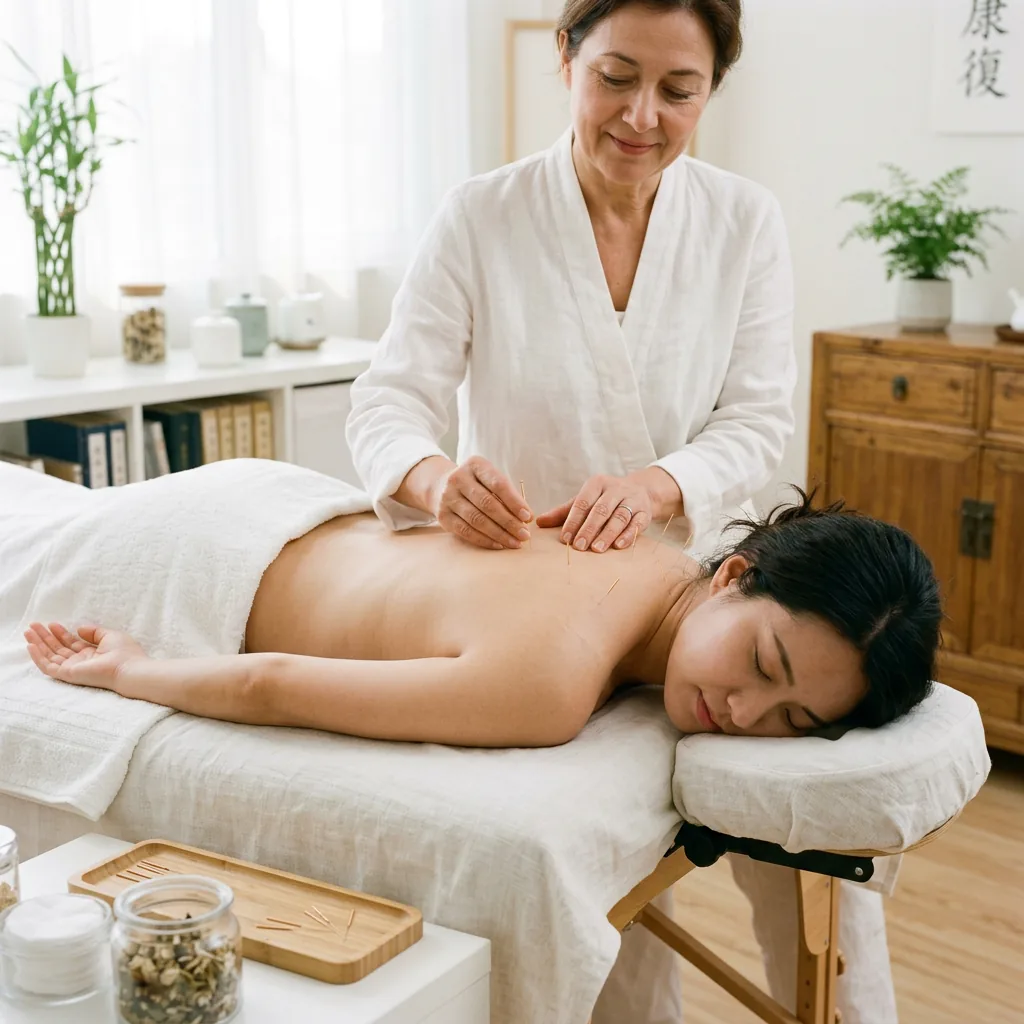
The mechanism question is genuinely open, and it is worth being precise about what "open" means. Researchers hypothesize that needling stimulates sensory nerves and may nudge the autonomic nervous system away from fight-or-flight and toward its parasympathetic, rest-and-digest mode — with proposed contributions from endorphins, serotonin signaling, and changes in stress-hormone activity. These are plausible, partially supported ideas, not settled physiology. Anyone who tells you acupuncture "resets your cortisol" is decorating a hypothesis with certainty it has not earned. That one sentence is the acupuncture stress mechanism debate in miniature: a plausible story, partially supported, routinely oversold.
There is also a less glamorous mechanism hiding in plain sight: the session itself. For 30 to 60 minutes you lie still, warm, phone out of reach, in low light, with nothing required of you. Heart rate settles. Breathing lengthens. For many high-output professionals, this is the only structurally enforced rest in their week — and enforced rest is not a placebo. It is rest.
We think patients deserve both halves of that sentence. Many people leave a session feeling unmistakably calmer; that felt benefit is real, repeatable, and worth something on its own. Whether the needles contribute a specific physiological effect beyond the ritual and the rest is exactly what current research cannot yet cleanly answer. In practice, the two arrive together — and for someone whose problem is an unrelenting stress load, together may be all that matters.
And name what needles cannot do. Acupuncture does not treat major depression, panic disorder, PTSD, or a diagnosed sleep disorder — those belong with physicians and licensed mental health professionals, and nothing in a spa suite changes that. Where acupuncture may earn a place is alongside that care, as a scheduled hour that lowers the ambient noise. Practitioners here will say exactly this at a first visit, because overselling a calming therapy to a stressed person is its own kind of harm.
— 04
Massage brings its own evidence file.
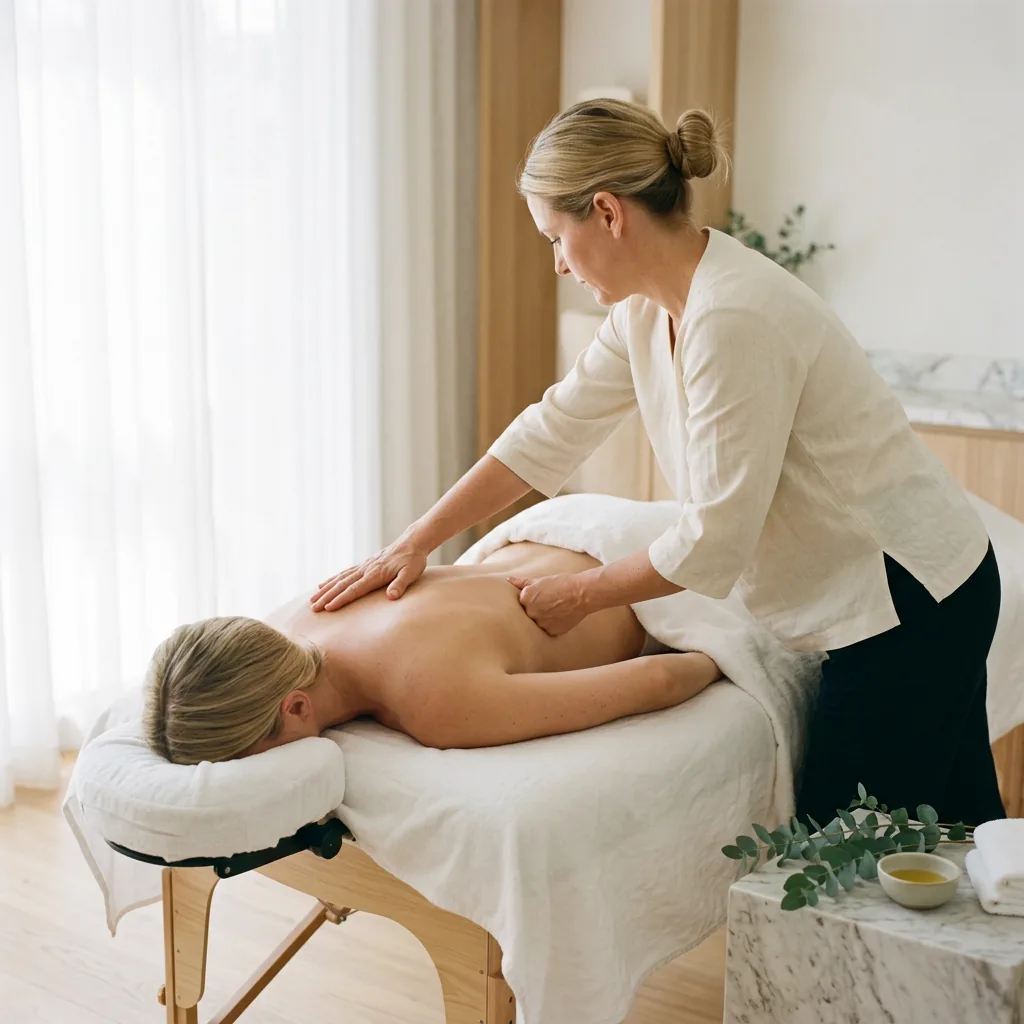
Acupuncture is not the only quiet hour on our menu, and for stress specifically, massage deserves a factual mention. If the acupuncture stress file is modest, the massage file sits in much the same place — worth knowing before you pick between them. Mayo Clinic Health System clinicians describe massage therapy as a reasonable complementary option for symptoms of stress, anxiety, and low mood, and the American Massage Therapy Association's position statement holds that massage can contribute to health and wellness — hedged, as position statements are, but grounded in a real trial literature showing short-term reductions in anxiety symptoms after sessions.
At Harmony, the massage side of the practice is meridian massage — bodywork built on the same TCM map as acupuncture, worked with hands instead of needles. A 60 minute session is $100, or $80 for members, and members add cupping, gua sha, or hot stone free (each is a $20 add-on otherwise). Membership is automatic with a package of 5 or more massage sessions — details live on the packages page.
Which door should a stressed, under-slept person walk through first? Honestly: whichever one you will actually keep showing up to. The evidence for both is strongest as ongoing practice rather than one-off rescue, and the calmest patients we see are the ones who made either therapy a standing appointment rather than an emergency measure.
— 05
A first acupuncture visit is mostly questions about stress and sleep.
If you have never done this, the shape of a first visit matters more than any evidence table, so here it is without mystery. The initial session runs 60 minutes and costs $150. The first stretch is conversation, and for stress and sleep it is specific: when you get into bed versus when you actually fall asleep, what wakes you at 3 AM, caffeine timing, alcohol, medications and supplements, screens, workload, and what a typical Tuesday actually looks like. Bring honest answers; vague intake produces vague treatment.
Then the treatment itself. You lie clothed on a warm table — loose sleeves and pant legs are enough access — while a licensed acupuncturist places thin sterile needles at points on the arms, lower legs, ears, and crown of the head. Placement takes a few minutes. The remaining 20 to 30 minutes are simply rest, lights low. Afterward, most people feel somewhere between loose and pleasantly foggy; drink water, and if you can, keep the evening quiet rather than sprinting back to the inbox.
Cadence and coverage
Follow-up sessions are 30 minutes at $100, and a package of 5 sessions is $400 — $80 per visit, which fits the weekly rhythm most stress plans use. On insurance: plans that cover acupuncture more commonly attach it to pain diagnoses than to stress or sleep, so verify before assuming anything.
We accept major insurances like UnitedHealthcare and Aetna — text your policy info to 240-715-5939 and we will run a free benefits check before you book.
— 06
A realistic plan for acupuncture, stress and sleep looks boring on paper.
Here is roughly how the acupuncture stress file, the acupuncture sleep file and the alternatives stack up — what the evidence review shows, stated at the confidence level the research supports:
| Approach | Target | What research suggests | Confidence |
|---|---|---|---|
| Acupuncture | Stress and anxiety | May reduce self-rated stress and anxiety symptoms | Moderate-to-limited; small trials |
| Acupuncture | Insomnia | Some improved sleep-quality scores | Limited; reviewers cite low-quality evidence |
| Massage | Anxiety symptoms | Short-term symptom reduction after sessions | Limited-to-moderate |
| CBT-I | Chronic insomnia | First-line treatment | Strong — ask your physician for a referral |
A typical plan at our clinic: weekly 30 to 60 minute sessions for 4 to 6 weeks, then an honest reassessment against markers you chose in advance — nights per week you fall asleep within half an hour, how often you wake at 3 AM, how your Sunday-evening dread trends. Our practitioners are licensed, and 15+ years of practice have made them comfortable saying "this is not moving; let's change course" when it is true.
Pair whichever therapy you choose with the unglamorous fundamentals — they are free, and they make every other intervention work better:
- Anchor the wake time. Same alarm all 7 days. It is the single highest-leverage sleep habit, and the least popular.
- Cut caffeine by early afternoon. Caffeine's long half-life means a 4 PM cold brew is still arguing with you at 10 PM.
- Dim the last hour. Screens down, lights low. Brightness at 10 PM reads to your brain as a wake signal.
- Keep the bedroom cool and dark. Around 65 degrees suits most sleepers; blackout beats willpower.
And watch for signs this is not a wellness problem: loud snoring with gasping or choking (possible sleep apnea — see a doctor), sleeplessness with chest pain or palpitations, or low mood that is sliding toward hopelessness. If you ever have thoughts of harming yourself, call or text 988 now — that outranks every appointment in this article.
— 07
Three quiet next steps.
If the evidence-first framing above matches how you want to be treated, starting is deliberately easy:
- Pick your marker before your first session. Write down two numbers this week — average nights of decent sleep, and your 1-to-10 stress rating at 9 PM. You cannot judge a therapy you never baselined.
- Book an evening slot. The clinic at 1481 Chain Bridge Rd, Ste 300 is open until 9 PM all 7 days, with free parking at the door — an after-work session beats another hour of inbox. Book online or call (240) 715-5939; details for first-timers are on our McLean acupuncture page.
- Keep your doctor in the loop. If you take sleep or anxiety medication, or suspect apnea or depression, acupuncture belongs alongside medical care, not in front of it. Bring your physician the same honesty this article owes you.
None of this is dramatic, and that is the point. Stress care that works tends to look like maintenance rather than rescue — a standing hour, a steady wake time, honest numbers, and clinicians who tell you plainly what the evidence does and does not show. Start with one of the three steps this week; the other two follow more easily than you would think.
This article is general health education, not medical advice. Acupuncture and massage may support relaxation; neither treats depression, anxiety disorders, or sleep disorders in place of professional care. Persistent insomnia and persistent low mood both deserve a physician's evaluation.
— Questions
Asked & answered.
How many acupuncture sessions before sleep might improve?
Can acupuncture replace therapy or sleep medication?
What does a stress-focused acupuncture session feel like?
Can I book evening appointments after work in McLean?
— Research & references
NCCIH — Sleep Disorders and Complementary Health Approaches
Evidence that acupuncture improves insomnia is limited; relaxation techniques show more consistent, though still modest, support.
NCCIH — Stress
Some mind-body and relaxation-based practices may help reduce stress symptoms, though many studies are small.
Mayo Clinic Health System — Massage for Depression, Anxiety and Stress
Clinicians describe massage as a reasonable complementary option that may ease stress and anxiety symptoms alongside standard care.
Citations are summarized — please consult the original sources. This page is general health education, not medical advice for your specific case; results vary and acupuncture works best alongside, not instead of, care from your physician.
— Keep exploring
Condition
Acupuncture for Anxiety & Stress
The full evidence review, session experience, and treatment cadence.
Condition
Acupuncture for Insomnia & Sleep
What limited research shows, and where CBT-I fits first.
Location
Acupuncture in McLean, VA
Chain Bridge Rd clinic — evening hours, parking, and booking.
Service
Meridian & Tui Na Massage
TCM bodywork at $100 per 60 minutes — $80 for members.